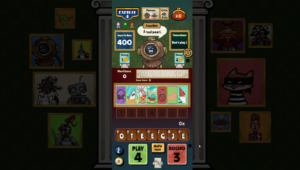
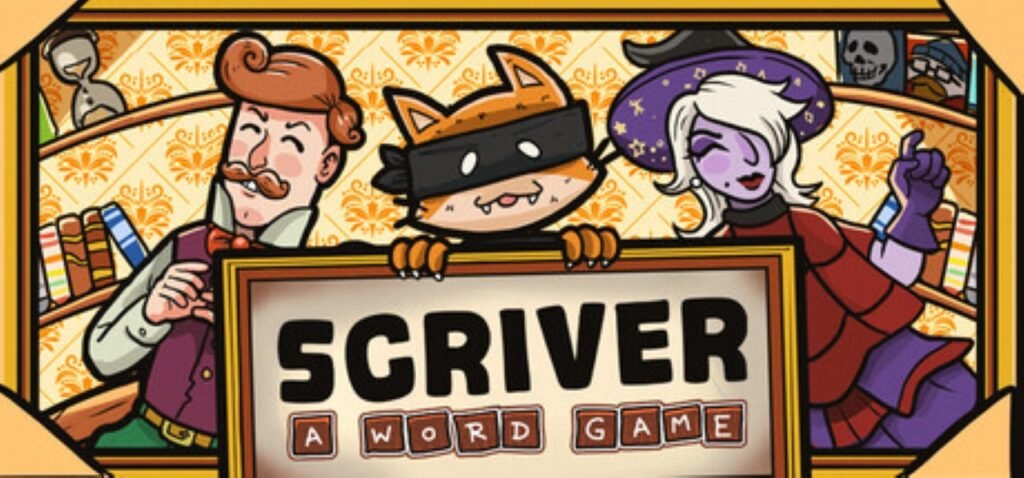
Each run of Scriver: A Word Game, developed by doughbody and released June 24, 2026, puts you in charge of a small art gallery where you buy, arrange, and sell paintings, then play words to satisfy visiting critics. The word-playing is the scoring mechanism: letters combine with the abilities of your exhibited art pieces to generate points, and the goal is to impress each critic enough to advance toward a final exhibition.
The gallery management and the word game are inseparable. Art pieces carry individual abilities that interact with specific letters, word lengths, or tile positions, so curating the gallery is also curating what kinds of words score well. Over 120 works of art are available across runs, alongside 20 books that modify individual letters, 15 albums that reshape the deck as a whole, and 10 drinks that upgrade word traits. The gift shop is where these items enter your run, and the purchasing decisions there determine which synergies become available. Six starting decks give each run a different opening shape, and six challenge modes alter the rules further for players who want structural variety beyond the standard arc.
Critics and patrons are drawn from a cast of more than 25 characters, each with a distinct mechanical personality. Bandit the Cat removes an art piece mid-round; Garrrth the Pirate penalizes consonants; Sir Righteous the Knight disables the rightmost letter played. These characters can appear on either side of the table, as patrons who help or critics who impose constraints, which means the same character shifts from asset to obstacle depending on context. Twenty-five exhibit awards add another layer of run-shaping bonuses on top of the art and item systems. An endless critics mode strips away the endpoint for players who want to keep stacking difficulty.
Players who want action-driven combat or narrative progression will find little to hold them here; Scriver is entirely a numbers and language puzzle, and a run lives or dies on vocabulary range meeting mechanical build. The art is hand-painted by Irene Da Lio and the original soundtrack is by Taiel Ramírez, giving the game a distinct visual and audio texture. Twenty-five achievements and a deep item pool support replayability without requiring any single run to last long.