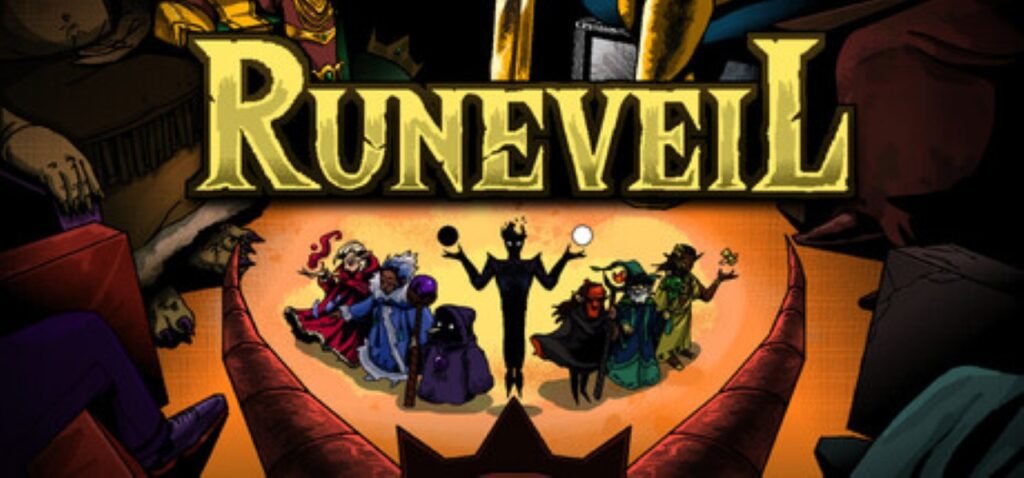
Most roguelike deckbuilders ask you to pick the right card at the right moment; Runeveil, from developer dicehit, makes that question irrelevant by forcing you to commit your entire hand at once. The order in which you arrange those runes before the turn resolves is the strategic act — positioning is damage, and a misplaced rune can collapse a chain that would otherwise have cleared the fight.
Players choose from elemental wizards, each built around a distinct school of magic with its own rune pool and mechanics. Early Access launched with four wizards covering Nature, Fire, Water, and Arcane, with the full game targeting seven. Runs move through arenas, each with its own enemy roster, mini-bosses, and a Sin King as the final encounter. Seven Sin Kings across seven arenas form the full gauntlet, and beating one unlocks ascending difficulty tiers that stack modifiers and strengthen enemies, extending a run’s ceiling well past the first clear.
Outside the sequence-building itself, the game layers artifacts, potions, scrolls, and enchantments onto individual runes. Artifacts can bend how runes interact with one another, and the design explicitly supports runaway multiplier chains and looping builds. Rewards are visible before a fight begins, so deck direction can be set from the opening room rather than discovered mid-run. Separate progression tracks exist for individual wizards — each has a level-based skill tree — and a global talent tree accumulates experience across all runs to provide benefits that carry forward universally.
The update history shows a game that moved through sustained public iteration before its June 23, 2026 release. A public demo appeared in April 2026 and received a series of rapid patches through May, adding experimental Steam Deck and controller support along the way. A sizeable v0.4 patch landed during Steam Next Fest in June, followed by the Early Access launch and immediate day-zero and day-one hotfixes. By July 2026, patch 0.5.3 introduced a dual-deck rework and new assets, indicating that core systems were still being restructured shortly after launch. A December 2025 entry describing a complete overhaul suggests the game underwent substantial redesign even before the demo phase began.
Runeveil occupies a narrower mechanical lane than Slay the Spire, trading that game’s broad card-selection expressiveness for a combinatorics puzzle where sequencing a fixed hand cleanly is itself the skill.