

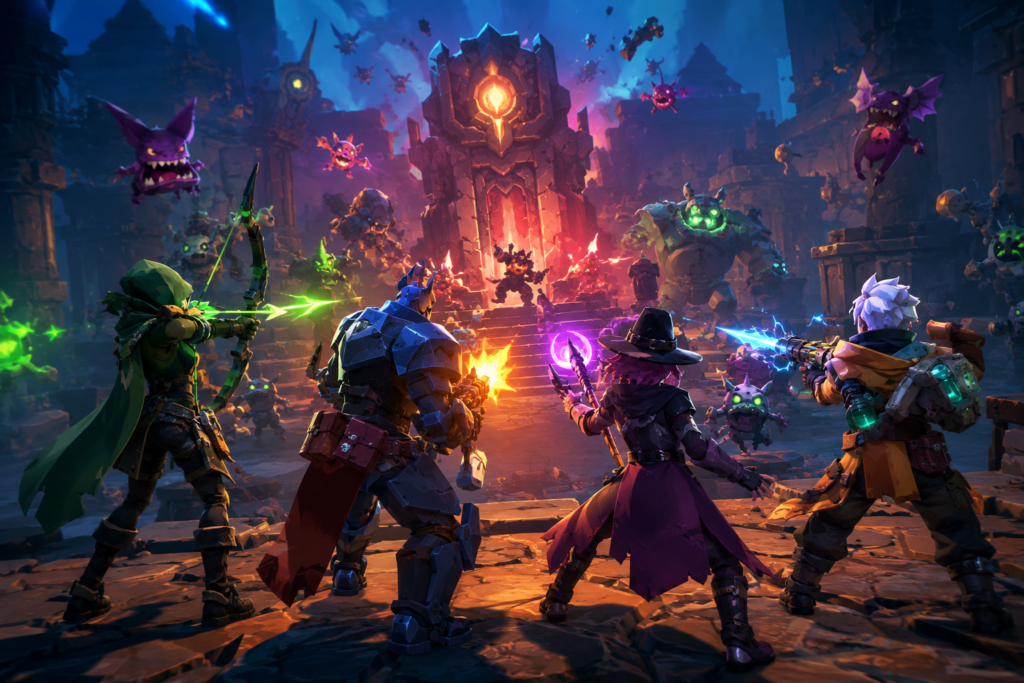
Looking for the best co‑op roguelites to play with friends? We’ve got you.
Co‑op changes the genre in ways no patch or update ever could. Roguelites are already built on uncertainty, but the moment you add other people, the entire experience tilts.
The systems, rooms, and randomness all remain the same. What changes is the chemistry, the way a group reacts, adapts, and occasionally implodes when the run takes a turn nobody saw coming.
That’s why co‑op roguelites hit the way they do. The game doesn’t need to manufacture drama, the players do it for free. One decision shifts the run and one moment of hesitation reshapes the plan. One unexpected interaction sends everyone scrambling, laughing, arguing, or doubling down. The content isn’t expanding, but the possibility space is, because every friend you bring into the run rewrites how the whole thing plays out.
Here are five that do the co-op experience better than most.
1. Ravenswatch
Fairy‑tale heroes aren’t supposed to fight nightmares pulled straight out of cosmic horror, but Ravenswatch doesn’t care about supposed to. It takes characters you think you know, Little Red Riding Hood, Beowulf, Sun Wukong, the Pied Piper, and rebuilds them into some of the most compelling roguelite kits in the genre. Not because they’re edgy reinterpretations, but because their abilities actually matter once you’re in the run.
Ravenswatch is perfectly strong as a solo experience, but the moment you bring friends, the whole thing shifts. Each hero bends the rules in a different direction, and those differences start colliding in ways the game never spells out. One character covers gaps another can’t. Someone’s ultimate turns a losing fight into a winning one. A build you thought was straightforward suddenly becomes the backbone of a team strategy that didn’t exist five minutes ago.
That’s the quiet trick Ravenswatch pulls off: the more players you add, the more the game reveals. Not through new content, but through new possibilities.
2. Windblown
Windblown feels like someone looked at a fast‑paced action roguelite and decided the speed limit was optional. It’s a game that never stops moving, not for breath, not for clarity, not for you. Coming from the team behind Dead Cells, that restlessness makes sense. Every run is a blur of dashes, strikes, and split‑second pivots, the kind of pace where thinking too long is going to get you killed.
The interesting part is what happens when you add friends. Windblown doesn’t slow down to accommodate co‑op, it accelerates. Suddenly the chaos multiplies. Someone’s repositioning, someone’s overextending, someone’s trying to salvage a fight that went sideways three seconds ago. The game doesn’t ask you to coordinate, it forces you to, because surviving alone is hard, and keeping everyone else alive is the real challenge.
Windblown isn’t about mastering a build so much as mastering momentum. With a full group, that momentum becomes something you’re all responsible for, whether you’re ready or not.
3. Ember Knights
Ember Knights starts with a simple premise and then immediately breaks it. What if a roguelite just let you be absurdly powerful from the jump? Every swing, dash, and ability feels like it’s part of a system begging to be pushed further than intended. Weapons hit hard, relics stack in strange ways, and upgrades twist your build into shapes you didn’t see coming until you’re already committed.
And that’s the solo experience. Co‑op turns it into something else entirely.
The moment more players enter the arena, the screen becomes a living diagram of cause and effect. Someone triggers a chain reaction. Someone else amplifies it without meaning to. A relic combination you barely noticed suddenly becomes the backbone of a team strategy that shouldn’t work but absolutely does.
Ember Knights thrives when everything is teetering on the edge of too much. Add friends, and it finally tips over in the best possible way.
4. Lost Castle 2
Lost Castle 2 doesn’t bother pretending to be anything other than what it is. No elaborate systems waiting to be deciphered, no genre‑bending twist lurking in the background, just a group of adventurers carving their way through waves of enemies and grabbing whatever loot makes the next room slightly less fatal.
It’s straightforward in a way most modern roguelites aren’t, and that simplicity ends up being part of its charm.
The sequel builds on the original without overcomplicating it. More weapons, better progression, cleaner build variety; all the things players actually wanted, delivered. In co‑op, that simplicity becomes a strength. New players can jump in and immediately understand what’s happening, while veterans still have enough depth to chase smarter builds and tighter runs.
Lost Castle 2 doesn’t need a gimmick to work, it just needs a group willing to dive in and see how far they can push a run together.
5. Shape of Dreams
MOBA‑inspired roguelites aren’t exactly a crowded field, which is why Shape of Dreams stands out. It borrows the language of hero‑based combat, defined roles, distinct kits, clear identities, and drops it into a roguelite structure where every run reshuffles what those heroes are capable of. Abilities, weapons, upgrades… everything bends just enough to make each attempt feel like a new interpretation of the same character.
That flexibility becomes far more interesting once co‑op enters the picture. Heroes naturally fall into roles, but the game never locks you into them. Instead, it nudges teams to experiment, to lean into odd combinations, to build around each other’s strengths in ways that feel discovered rather than designed.
One run you’re supporting, the next you’re carrying, and the game never stops offering new ways to twist those dynamics.
Which Co-Op Roguelite Will You Try?
Co‑op roguelites work because of their fun unpredictability. Every game on this list approaches that idea differently. Ravenswatch with its shifting hero identities, Windblown with its breakneck momentum, Ember Knights with its escalating chaos, Lost Castle 2 with its stripped‑down clarity, and Shape of Dreams with its role‑bending flexibility. None of them rely on endless content to stay interesting. They rely on the players and the way a group reshapes a run simply by existing inside it.
The thing that bonds these games together is that a run becomes a negotiation, a gamble, a shared attempt to bend randomness into something that resembles a plan. Sometimes it works and sometimes it falls apart in spectacular fashion. Either way, you and your friends will have a blast.
Played any of the co-op games on the list? Let us know which is your favorite or which ones you recommend in the comments below 👇