

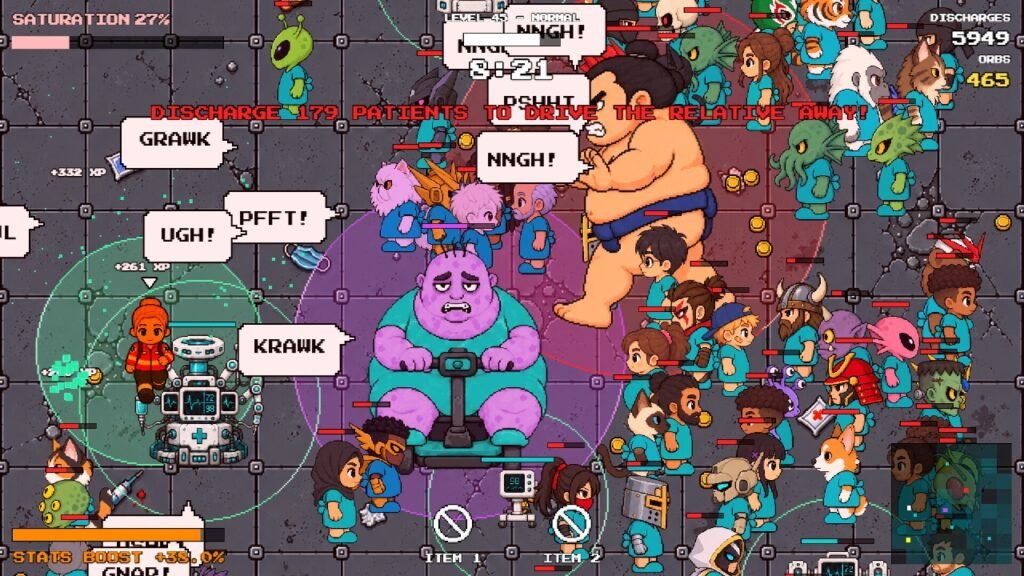
In most survivors-likes, the hundreds of characters filling your screen are trying to kill you. In Critical Ward, they’re patients who need medical attention.
Instead of fighting through waves of enemies, you’re trying to keep a hospital functioning as its corridors fill with sick patients, contagious outbreaks, hostile relatives, and increasingly difficult decisions about who needs your attention first. Your job is to treat as many people as possible, keep your combos going, and stop the hospital from becoming completely overwhelmed.
Patients actively move away from you, which means positioning can be used to influence where crowds gather. Different playable characters have their own strengths and restrictions, and certain item combinations can turn a run that’s falling apart into something surprisingly manageable.
Ahead of its release, we spoke to the solo developer, BiEsEl Games, behind Critical Ward in an exclusive Q&A. We talked about what sets it apart from other survivors-likes, the secrets hidden in its characters, how players can recover when a run starts going wrong, and why more than 200 hours of playing his own game haven’t put him off starting another one.
There are a lot of survivors-likes fighting for our time these days. What’s the thing Critical Ward does that you think might win someone over who’s already played a dozen of them?
Bernat: The big difference is that the horde is something you’re trying to save, and it’s actively running away from you.
You’re constantly deciding the best route to keep your combo alive while managing outbreaks, avoiding hostile relatives, and occasionally dropping everything because that elusive Combo Duck has appeared somewhere on the map.
I wanted to make something everyone could have fun with, which is also why nobody actually dies in Critical Ward. It’s the hospital itself that becomes saturated.
Underneath that, though, it has the attitude of an arcade game: fast, direct, slightly mean, and hopefully very hard to put down.
How different can two runs actually get? If I play for an evening, am I going to start seeing the same builds come together, or is there enough going on that the game can keep surprising me?
Bernat: The characters play very differently. The ones that initially look the most powerful usually come with some kind of disadvantage that you gradually discover and have to adapt your playstyle around.
Some characters that look weaker have strengths whose descriptions are deliberately left a little open to the player’s interpretation and intuition.
Learning a character is part of the game. Once you understand what they’re really good at, the way you route around the map, value upgrades, and react to problems can change completely.
Playing a different character can make Critical Ward feel like a very different game. I have a particular weakness for MED-BOT, personally.
Are there secrets tucked away for the people who like poking at every corner of a roguelite?
Bernat: Definitely, and some of them are tied directly to what I mentioned about the characters. I don’t want every mechanic to arrive with a paragraph explaining exactly how to exploit it. Some characters, traits, and interactions are intentionally written in a way that rewards curiosity, experimentation, and intuition.
There are unlocks and unusual interactions that I’d much rather have somebody discover during a run and think, “Wait… does that mean I can do this?” than have me spoil in advance.
So yes, there are secrets. I’m just going to be very annoying and not tell you what they are.
How much does keeping patients alive actually change the usual survivors-like rhythm? Is there ever a point where you have to sacrifice one problem to stop five others getting worse?
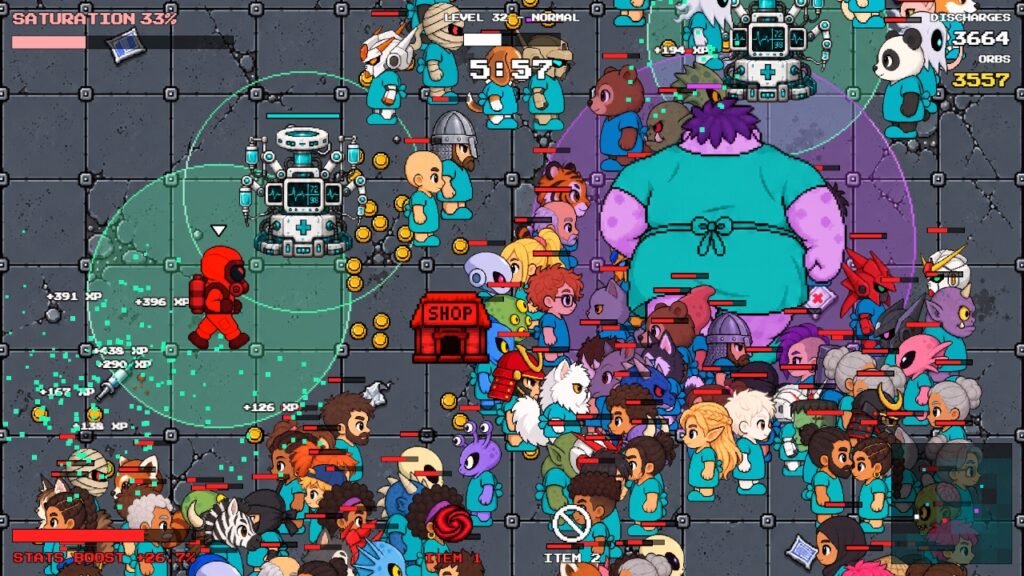
Bernat: Constantly. That prioritization is probably one of the biggest differences. With hundreds of patients on screen, treating whoever happens to be closest is rarely enough. A contagious patient could be making an entire area worse, a relative could be disrupting your route, saturation could be climbing somewhere else, and your combo is always asking you to keep moving.
Sometimes the correct decision is the one that costs you part of the build you’ve spent the run creating, because keeping everything intact would create a much bigger problem thirty seconds later.
You’re not really managing individual patients anymore. You’re managing the state of the whole hospital.
Can things snowball in the other direction too? If a run starts going badly, can a good player rescue it, or are there moments where you know the hospital is doomed and you’re just delaying the inevitable?
Bernat: One of my main goals was to keep giving the player options, even when things look terrible. For example, and I’m probably saying too much here, patients always spawn away from the player and constantly try to move farther away from them. So if I have an area packed with useful infrastructure, maybe I can deliberately position myself somewhere else and effectively push the crowd towards it.
Then you start combining systems. There’s an item that temporarily increases your range, and another that treats patients around you while multiplying that range. Those sound like two completely separate tools, but combining them suddenly sounds like quite a good idea, doesn’t it?
That’s the kind of recovery I want. A run can absolutely deteriorate, but understanding how its systems interact should keep giving a good player ways to fight back. In endless play, of course, eventually the hospital is supposed to win. The interesting question is how long you can keep refusing to let it.
What’s been the hardest part of Critical Ward to get right? Not necessarily technically, just the thing you’ve gone back and forth on more times than you’d care to admit.
Bernat: Surprisingly, the hardest part has been deciding what shouldn’t be in the game. There have been a lot of ideas, mechanics, characters, and even maps that I added, tested, adjusted, and eventually removed, simply because they weren’t adding anything new or making the game more fun.
That went completely against the goal I set myself: nothing in Critical Ward should feel like filler. I’ve played more than 200 hours of the game at this point, and I’m genuinely proud that more than half of those hours came from runs I played simply because I felt like playing it.
I’m Critical Ward’s number one fan, admittedly also its only fan for now!
After almost a year of development, having my own game still be the game I most want to play is about the best result I could have hoped for. Critical Ward isn’t trying to offer the complexity of a Souls game. It’s an arcade game. The goal is much simpler: when a run ends, I want you to feel like starting another one.
What does progression look like between runs? Are we unlocking more options, getting permanently stronger, or a bit of both?
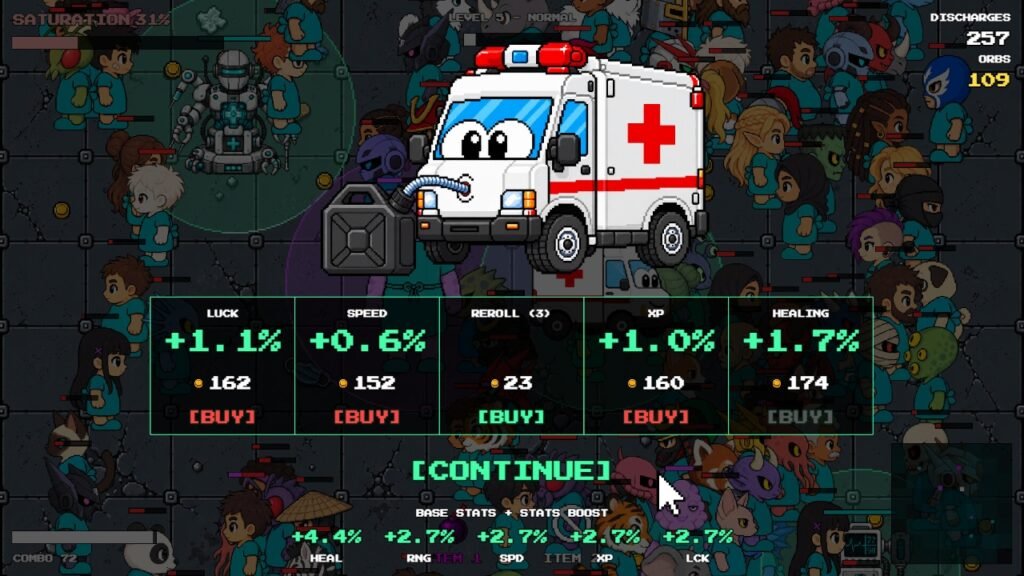
Bernat: It’s primarily horizontal progression rather than a permanent stat grind. You unlock new playable characters, and they aren’t just stronger versions of the starting roster. They have different advantages, restrictions, and mechanics that can significantly change how you approach a run.
Most of your actual power is still earned during the run itself, so learning the game remains more important than simply accumulating permanent bonuses. That structure also gives me plenty of room to expand the experience later without making the characters and options players already enjoy obsolete.
What haven’t we seen in the demo yet that you’re particularly excited for players to get their hands on?
The characters. I really want people to try all of them, work out their secrets, chase their achievements, and discover which one completely clicks with them. And then there’s everything surrounding them. There are more than 120 different characters across regular patients, contagious patients, police officers, relatives, and the rest of the hospital population.
I want the player to keep spotting something new, finding a different interaction, or discovering another way to approach a run. The dream is that someone starts a run thinking they’ll play for five minutes and then suddenly notices the timer says twenty.
Oh, and the soundtrack. I’m really looking forward to people hearing the whole thing.
How much does luck matter? Can a really good player drag a terrible run over the finish line, or can Critical Ward occasionally just decide today isn’t your day?
Bernat: There’s absolutely a luck factor, but the player never stops being the director of the run. Luck might help you reach the build or situation you’re aiming for sooner rather than later, and it can obviously make certain moments go your way. But it shouldn’t be the thing deciding whether you were allowed to succeed.
The decisions are still yours including where you move, what you prioritize, what you build around, and how you react when several things go wrong at once. Luck can change the route. It shouldn’t take the steering wheel away from you.
How are you thinking about the game after launch? Is this something you want to keep expanding if players take to it?
Bernat: Absolutely. More than anything, if Critical Ward finds an audience, I’d love to actually talk to those players. Find out what they enjoy most, what they don’t, what they’d like to see expanded, and what they think could be improved.
I already have ideas for expanding the game, but I think it would be far more interesting to develop those ideas alongside the community rather than in isolation. And the intention is very simple…No microtransactions. Additional content would be free.
I’ve really enjoyed making the game that I want to play. If I get the chance to keep making the game that I and a community both want to play, I think I’d enjoy that even more.
Critical Ward Launches Nov 2nd
Critical Ward has a rather different idea of what a survivors-like should be, and it’s one that could make for some interesting runs. Having hundreds of patients actively avoiding you changes how you move around the map, while contagious outbreaks, hospital saturation, and character-specific mechanics give you more to think about than simply finding the next damage upgrade.
There’s also quite a bit left for players to discover. The developer is keeping quiet about some of the more unusual character interactions, the full roster goes beyond what’s available in the demo, and more than 120 different characters make up the hospital population.
The game launches on Steam on Nov 2nd 2026. For now, there’s a demo to get stuck into, with the full game promising more characters, achievements, secrets, and plenty of opportunities to discover just how badly a hospital can go wrong.
Thank you so much, Aimee!
You really captured the spirit (and chaos!) of Critical Ward. I had a great time answering your questions, and some of them genuinely made me think about things I’d never really put into words before!
I really appreciate you taking the time to feature my little project and share it with your audience. It means a lot! 🙂
Thanks again! 0
0