

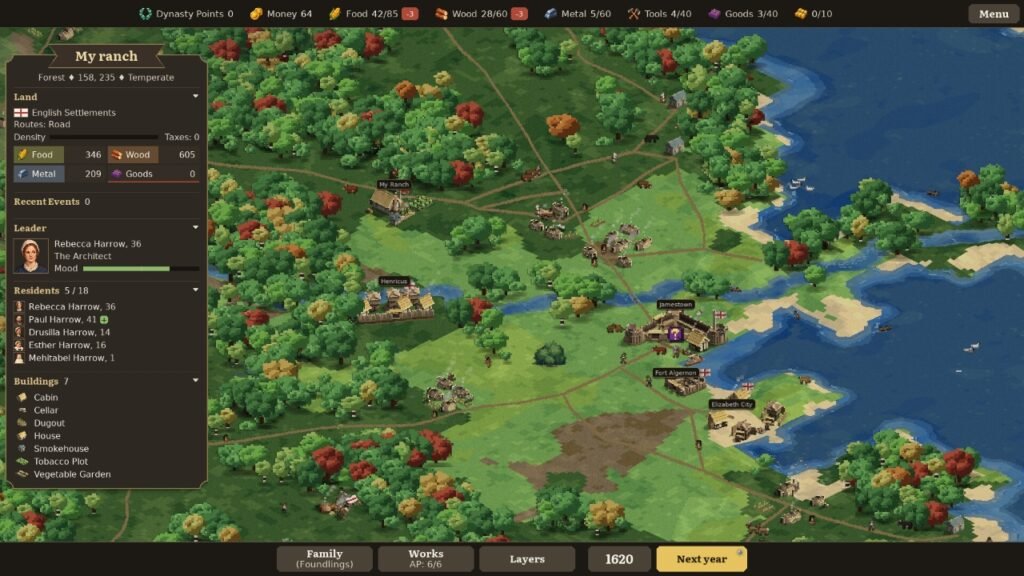
A small wooden house stands beside a patch of freshly planted crops. There’s food to grow, livestock to look after, and a family depending on you to make sure everyone survives another year. Beyond your little homestead, the American frontier is changing. New settlements are appearing, traders are establishing routes, and conflicts are beginning to reshape the land. You have no idea what the next few years will bring, let alone the next three hundred. However, if everything goes to plan, the home you’re building today might still belong to your descendants centuries from now.
Salt and Soil: A Frontier Family Sim is a turn-based colony sim from solo developer DelosX launching into Steam Early Access today. Set on the American frontier between 1607 and 1900, it puts you in charge of a family whose fortunes will rise and fall across generations. You’ll establish a homestead, manage resources, raise children, and make decisions that could have consequences long after your original settlers are gone. The aim is to build something worth passing down, although keeping the family together might prove just as challenging as keeping everyone fed.
A Little Patch of Land and a Lot of Responsibility
Your family begins with a modest homestead and the rather daunting task of turning it into somewhere future generations can live and prosper. You’ll grow crops, raise livestock, construct workshops, and trade whatever your household produces. Every new building requires resources, and every job needs someone available to do it.
That means deciding how to divide your family’s time between the things you need immediately and the improvements that might make life easier several years down the line. Perhaps you’d like to expand your farm and produce more goods to sell. Unfortunately, that could mean taking someone away from gathering food or maintaining the buildings you already have.
While investing in your homestead sounds sensible, spending everything on improvements could also leave your family struggling when a particularly difficult year arrives. It’s the sort of resource management where a decision that seems like a good idea today may become a serious problem several turns later.
One Year, One Turn, and Plenty of Family Arguments
One of the more interesting mechanics in Salt and Soil is how time progresses. Every turn represents an entire year, and each year ends with a Family Council where you’ll decide how to handle the latest developments affecting your household.
These aren’t simply random events appearing on a screen. The decisions are shaped by what’s actually happening in your campaign, including your family’s circumstances and events unfolding across the wider world. You may need to decide whether to welcome a newcomer, invest valuable resources in an opportunity, or send a family member away to learn a trade. Each choice can affect your supplies, relationships, and the people available to help run your homestead.
The Family Council also uses generative AI to create narrative events and choices based on your campaign’s current situation, with the resulting content checked against the game’s rules before being presented. It’s an unusual approach that could make each family’s story develop differently. You might spend years carefully preparing for a particular future, only to find yourself making a difficult decision that changes everything.
Your Children Will Inherit More Than the Farm

While building a successful homestead is important, Salt and Soil is ultimately about the family living there. Children grow up, relatives marry, and new generations gradually take the place of those who came before them. Family members have their own traits and relationships, so the household you’re managing fifty years into a campaign could be very different from the one you started with, and eventually, the person you’ve been guiding will die.
When that happens, an heir takes over, inheriting whatever home, resources, and circumstances the previous generation has left behind. Maybe you’ve established a thriving ranch with plenty of supplies and a successful trading business or your descendants will inherit a struggling farm, a collection of damaged relationships, and several problems nobody managed to resolve. Either way, they’ll have to make the best of it.
A family tree records births, marriages, deaths, and succession, allowing you to follow the people who helped shape your settlement over the centuries.
History Isn’t Going to Wait for Your Harvest
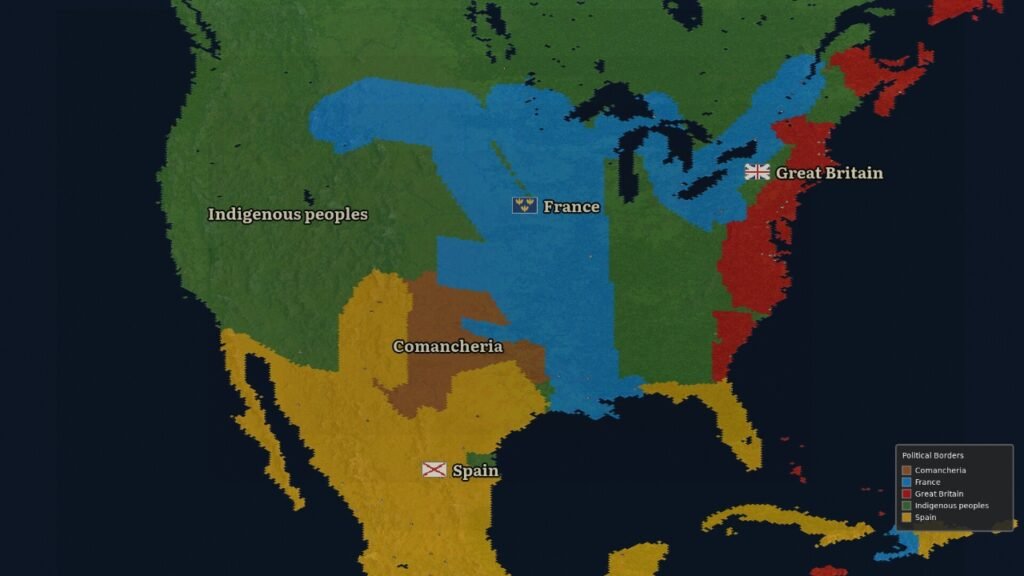
Your family may be concentrating on its own little corner of the frontier, but the rest of North America isn’t standing still. Across the game’s nearly three-century timeline, towns expand, borders change, and trade routes shift. Wars, migration, gold rushes, and the arrival of railroads all influence the world surrounding your homestead.
You’ll also interact with neighboring settlements and Indigenous nations through trade, cooperation, and relationships that can become strained as circumstances change. Bandit threats and wider conflicts can create additional problems for a household already trying to balance its resources.
The historical setting is an important part of the experience, with developer DelosX drawing on historical research to recreate the changing continent. Rather than building a settlement in a world that remains largely the same, you’ll need to adapt as new opportunities appear and familiar arrangements disappear.
A trading route that once helped your family prosper may become less useful, while the arrival of a railroad could open possibilities that earlier generations could never have imagined.
Three Centuries Is a Long Time to Keep the Family Business Running
Salt and Soil launches into Early Access today for Windows and Mac. The complete 1607-1900 campaign is already playable, although the developer plans to expand character systems, businesses, and the economy ahead of a full release targeted for the first half of 2027. An internet connection is currently required for the AI-generated Family Council events.
What makes the premise unique is the idea that you’re never really starting over when one character’s story ends. Their decisions become part of the next generation’s circumstances, and the homestead gradually develops into something shaped by hundreds of years of family history.
By the time 1900 arrives, that little wooden house you started with might be the beginning of a remarkable family dynasty. Or perhaps your descendants will still be wondering why their great-great-grandfather thought building another workshop was more important than stocking up on food.